[symple_box color=”red” text_align=”left” width=”100%” float=”none”]Warning: geeky technical post![/symple_box]

Google tag manager is the tool from Google that enables tracking tags to be easily (?) set, audited, modified and updated with lessened need for time-consuming web developer input. It’s a great idea that will enable clients and online marketing agencies to have much more flexibility in the updating of their website tracking and advertising, including:
- Adwords remarketing tags
- Adwords conversion tracking
- DoubleClick advertising scripts
- Custom HTML tags
- Custom image tags
- Google Analytics scripts
It’s confusing OK?
Google’s tag manager is still in it’s infancy so the resources out there are limited and quite confusing in many cases. I wrote this post about four months ago and got so fed up of trying to understand little details that I gave up, but have returned to finish the job in a half-arsed and still-quite-confused manner. If it still doesn’t make any sense please do tell me or let me know where I’ve gone wrong!
associated resource: Google Developers tag manager guidance
tag manager container
To get started you’ll need your developer to insert the tag manager container script on every page on your website immediately after the opening <body> tag. It’ll look something like the below with a load of extra code where I’ve put ‘…’:
[symple_box color=”blue” text_align=”left” width=”100%” float=”none”]
<!– Google Tag Manager –>
<noscript><iframe src=”//www.googletagmanager.com/ns.html?id=….</script>
<!– End Google Tag Manager –>
[/symple_box]
This is, in essence, giving you a custom area on each page where tag manager can insert some more code without having to get developers involved. Lovely and responsive eh?
It doesn’t support asynchronous tags, like A/B split testing tools, or those with document.write().
This is the easy bit, so if you have trouble here I recommend you give up and go home!
associated resource: tag manager developer documents
tag manager security
Security could be a concern for many companies, as the tag manager essentially can allow script to be entered into a website without the developer’s knowledge. As such it’s important that you strictly in control and are extremely careful with access to tag manager, and only give access to selected and highly trusted personnel or agency staff.
Different permission levels can be applied to users to enable them to view / view and edit / view, edit, delete and publish. This makes it quite possible to restrict external parties to ‘view only’ access (although this can then defeat the point of tag manager and removes the flexibility it provides to web agencies like Attacat).
The recommended setup is:
Account: Your company/agency
Containers: Set one container for each site/client
associated resource: tag manager setup
google analytics with google tag manager
The default (basic ) asynchronous Google Analytics script can be inserted onto every page of the site using tag manager. Simply select a single Google Analytics tag and select “Page View” as the track type. Add the default ‘all pages’ rule to fire the tag on all pages.
However if you want to insert customised versions of the code – so anything involving cross domain tracking, custom variables or fancy custom scripts – it needs to be inserted using the custom HTML tag in tag manager.
data layer
In order to track more advanced functions including revenue generation it is necessary to communicate through a ‘dataLayer’. This is where is starts to get pretty complicated…
Essentially the dataLayer holds all the information you’re looking to pass onto Google Analytics or some other tool, and the tag manager container simply gathers the data it needs on different pages. It also means that things can be tweaked on a page but the dataLayer can remain consistent. Different pages can output different data variables to the dataLayer within its JavaScript tag; for example a checkout page is likely to want to output conversion and revenue data for purchased items.
The dataLayer snippet should be implemented before the tag manager snippet.
[symple_box color=”blue” text_align=”left” width=”100%” float=”none”]
<script>
dataLayer = [{
// enter data here
}];
</script>
[/symple_box]
There are a huge number of things that can be communicated in the dataLayer, from page titles and URLs to demographic data, and you can really add as much as you see fit. It can be a pretty intense and difficult process, however, so it’s best to start with the minimum requirements and build from there. Usually that starts with ecommerce tracking.
associated resource: tag manager dev guide, tag manager reference guide
ecommerce tracking with google tag manager
In order to track revenue in Google Analytics using tag manager the developer will need to setup the aforementioned dataLayer to output transaction data on any receipt or purchase confirmation pages.
Add Analytics tags to the tag manager container
Specific rules can then be used within tag manager to fire the ecommerce tracking tag only on these desired pages and read the revenue data output in the dataLayer.
1. Output your transactional data according to the Google Analytics data layer spec. This is the only coding that you will need to do. You can read the details of the data layer here: http://troni.me/RoHAYE
2. Add a Google Analytics tag to your container. Enter your Google Analytics Web Property ID. The choose Ecommerce as the tag type. Finally, create a rule so it will only fire on the thank you page. See the image below for more info.
3. Make sure that you specify the profile is an Ecommerce profile in the Google Analytics Profile Settings. This just enables the ecommerce reports in Google Analytics. You have to do this in the regular setup as well.
While there are many potential variables, the only required dataLayer variables for ecommerce Analytics tracking are as follows. These should be implemented on any receipt or purchase confirmation pages:
transaction data – required
Variable Name Description Type
transactionId Unique transaction identifier string
transactionTotal Total value of the transaction numeric
transactionProduct data – required
Variable Name Description Type
id Product ID string
sku Product SKU string
price Unit price numeric
quantity Number of items numeric
action and event tracking with google tag manager
Clicks of important buttons or calls-to-action (such as clicking ‘book now’ button) should ideally be marked up with action tracking to enable tracking. For each event you track, add a Google Analytics tag and select “Event” as the track type.
With tag manager the onclick action should call the dataLayer with markup of the following structure:
[symple_box color=”blue” text_align=”left” width=”100%” float=”none”]
<a href=”#” onclick=”dataLayer.push({‘event’: ‘event_name’});” >Call-to-action</a>
[/symple_box]
Then set up the following rule in Google Tag Manager:
[symple_box color=”blue” text_align=”left” width=”100%” float=”none”]
[/symple_box]
Then add a rule to fire on on the specific event.
It’s been suggested in forums that you can still call event categories, actions and labels (as with normal Google Analytics action tracking) using the following setup:
[symple_box color=”blue” text_align=”left” width=”100%” float=”none”]
onclick=”dataLayer.push({‘
[/symple_box]
To find the Web Property ID:
- In your Google Analytics account, navigate to Admin.
- Click the Tracking Code tab.
Enter the Tracking ID (which takes the form of UA-xxxxxx-xx) into the Web Property ID field.
Although this will communicate events to Google Analytics you might want it to pass on a little more info, such as the transaction value (monies!) or the URL of a clicked link or button. To do this you’ll need to include website variable in your dataLayer.
[symple_box color=”blue” text_align=”left” width=”100%” float=”none”]
dataLayer.push({'variable_name': 'variable_value'});
[/symple_box]
These variables can include form data submitted by a user, data on video playback, and other dynamic variables on your site that occur after the page has loaded.
To combine variables with an event the following structure is used as an example. I’m not too sure on how this structure and method applies to different variables – in the example ‘color’ is used but I’m not sure whether this can effectively be totally customised to anything you so wish or whether it has to following preset categories, so this requires a bit of checking:
[symple_box color=”blue” text_align=”left” width=”100%” float=”none”]
<a href="#"
   name="color"
   onclick="dataLayer.push({
     'color': 'red',
     'conversionValue': 50,
     'event': 'customizeCar'});">Customize Color</a>
[/symple_box]
associated resource: tag manager events
macros and rules
Macros are essentially the rules specified within tag manager to tell it when to fire a particular tag (on a particular page or occasion). They’re based around a number of main types, of which the following are most useful:
associated resource: tag manager macros
URL
These are simple rules that fire a tag based on the URL of a page. This allows you to fire certain tags on, say, thankyou or receipt pages. You can use regular expressions to contain a whole range of varied pages under one URL ‘theme’ too.
associated resource: tag manager macros
event
Once (or if) you’ve setup action and event tracking you should use the event macro to fire tags as required according to your event names:
[symple_box color=”blue” text_align=”left” width=”100%” float=”none”]
onclick=”dataLayer.push({‘event’: ‘event_name’});”
[/symple_box]
Apparently it’s also possible to specify event categories, actions and labels through use of macros, although I’m not entirely comfortable with how yet!
associated resource: tag manager forum discussion on event categories, actions and labels
Migrating tags to Google Tag Manager
If you already have a site and want to use tag manager, then obviously you’re going to have to migrate. First off all work out which tags are supported and which are not supported, and then follow the below best-practice guidance directly from Google:
- Map your site (optional)
To begin your migration, you’ll want to think about which tags you currently have deployed on your site and what data you’re trying to collect. For data collection think about what actions you want to track (events) and what additional data from the page you’ll want to collect (variables). Create a map of tags, the data you want those tags to collect, and which events or pages you want to associate with those tags.Remember that Google Tag Manager cannot support any synchronously loading tags (like AB testing tags, see the full list of unsupported tags) or tags withdocument.write(). If you are thinking about migrating these types of tags, remove them from your list. - Implement standard Google Tag Manager snippet
Once you’ve mapped your site, you’ll want to install just the single Google Tag Manager snippet on your site (empty) and deploy it. See Quick Start for more information. - Add Events and Variables
Customize your Google Tag Manager installation using the methods outlined in the Add Events and Variables section. - Add tags with associated firing rules in Google Tag Manager’s management interface
After you’ve completed setting up the site with the Google Tag Manager snippet and data collection APIs, you should add your site tags to the user interface. DO NOT publish at this time. Simply add and configure the tags from your site in the Google Tag Manager management interface using the appropriate templates and set up the firing rules appropriately (more information about how to do this in our Help Center Rules article). - Final migration swap
The last step is where you simultaneously swap out your old tags and publish your tags in Google Tag Manager. Within a few minutes of each other, you’ll want to:
- Remove your site tags in a single code push
- Once you know this push is successful, press the “Publish” button for your container version.
You can get a small gap in data in the swap, but such is life. It’s either that or a small bit of duplication, so just accept there’s going to be a little data leakage.
associated resource: tag manager migration
multiple domains
I think the easiest way to manage cross-domain tracking is by inserting a custom Google Analytics tracking code by directly inserting custom HTML, which we have talked about already.
associated resource: tag manager multi-domain tracking
checking and debugging
Use the rather excellent Tag Assistant and the Google Analytics debugger to check what data is being sent through to Analytics from your dataLayer. It helped me work out an ‘Analytics going mental’ situation recently!
associated resource: Tag Assistant (by Google), Google Analytics debugger
things to remember
- Tag manager and tracking code is case sensitive, so make sure it’s implemented exactly as required e.g. dataLayer not datalayer
- Make sure you aren’t duplicating your tracking codes (one in tag manager, one normal for example)!
- Variable names being passed through the dataLayer should be in quotes (e.g. ‘variable’)
- Ensure dataLayer variables are consistent across your sites and different pages
Last Friday night I found myself at the Bonham Hotel nibbling finger sandwiches and chatting with a mix of Edinburgh professionals. Networking event, you ask? Not exactly. I was taking part in Impact48, a weekend of collaboration and volunteering focused on benefiting one charity – Music in Hospitals Scotland. Impact48 is “all about creating something that is complete and real; something the charity can take advantage of immediately”, and I’m proud to say that I took part in this successful (and highly enjoyable) pilot weekend.
After meeting our fellow volunteers, we were introduced to the charity and began discussing what we could do to produce measurable positive results for Music in Hospitals. Following this introduction a brief break was suggested, but there was so much excitement in the room that ideas started flying before anyone could move from their seats, and several different directions for action began to emerge. They ranged from conservative to ambitious, from subtle to bold and daring. The collected thoughts were eventually refined and I set off home in happy anticipation of the remainder of the weekend. I basked in the energy and creativity of Friday night, so much so that I almost felt intoxicated!

Saturday morning found a group of us at the stunning Yard Digital offices, sipping some tasty coffee and approaching the previous night’s collection of thoughts and ideas with a eye to feasibility (though with no less enthusiasm).Within a matter of minutes a decision was made about which tracks to pursue; people with the necessary skills were allocated to appropriate tasks, and work began. The team, which comprised of software developers, designers, representatives from the charity and SEO experts jumped headlong into their tasks and worked together very competently The ease of collaboration was truly impressive, a fact I suspect was largely due to the atmosphere – everyone seemed filled with both willingness and a genuine desire to contribute.
Time flew and to be honest, the hours I spent coding didn’t feel like work at all. At the end of the day, I’d helped pull together a simple yet functional piece of code that should enable the people involved with Music in Hospitals to display their support on their own websites. Unfortunately, I wasn’t able to take part the following day, but I did stop by the Bonham again on Sunday evening to see how the team had gotten on. The group’s work was presented to a panel of ‘judges’ – all of whom seemed very pleased with the results of the weekend. I’m hopeful (as is everyone else) that what we produced will contribute to the success of the the charity immediately and further down the road.

What did I take away from the weekend? Several things:
- Education is crucial
- Collaboration is thrilling
- There’s a wonderful community of generous and talented people in Edinburgh
- A small amount of my time and skills can actually impact someone else in a big way
Having now worked at Attacat for a few months, I’ve been taught and have absorbed a fair amount of information about internet marketing (even though I’m meant to be a code monkey). Over the course of the weekend, I came to realise that what I’ve begun to take as common knowledge is in fact far more industry-specific than I would have guessed. Having experts on hand to perform site audits and provide a crash course in social strategy and SEO practices provided the charity with invaluable education. Perhaps the information they were given is not a tangible product built by a team in 48 hours, but knowledge and ideas are just as important to a business as fancy widgets and infographics. A little learning can go a long way, which gets me thinking about how Attacat might be able to reach out and share some of its own expertise for a good cause…
I would highly recommend participating in any future weekends like this. Keep up with @MiHScotland and @RealImpact48 to hear about the ongoing benefits of the weekend and plans for future events.

in short, no.
Or at least, not good account managers anyway. Between automated rules, conversion optimiser, product listing ads, ad rotation settings and now dynamic search ads, some PPC account managers could be forgiven for fearing all this automation threatens to leave them redundant in their job. Some could also be forgiven for championing the belief that this was always Google’s intention – to claim back that 10-20% of the client’s PPC budget that goes to agencies instead of on more clicks. In reality though, we’d be dangerously missing the point of our role as the intermediary between our clients and PPC. Regardless of the changes that occur in the tools we use, the level of competition will always stay constant and it’s maintaining a competitive advantage on behalf of our clients that we’re really tasked with.
don’t be evil
In terms of Google’s intentions, it’s immediately pretty clear they would never want to push agencies out of their roles just to claim back that 10-20%. Bringing an agency in to manage a PPC account can massively increase its efficiency and the budgets, and Google owes a huge amount of its success to understanding what the agency needs to grow the account, and help make PPC a lucrative and appealing industry for talented individuals to stay in.
driving value for everyone
For a start, the future is very bright for everyone involved. The advertiser, agency and supplier ménage-a-trois that the search engines have carefully nurtured benefits all parties involved and, most importantly also the end user whose buying habits drive the revenue. It’s easy to look at Google cynically as a gatekeeper to the internet that has managed to win the race to monopolise it and so charges a tax on online purchases, but what Google has actually done is provide an incredibly useful shopping tool that cuts out a huge amount of the wasted time and effort that used to plague commercial endeavours, and it’s from these measures to improve efficiencies that Google takes their cut.
the end of PPC
PPC is not dead and as it continues to evolve I don’t think it ever really will ‘die’. There’s no doubt that PPC is becoming more and more competitive for advertisers, but this means it’s maturing into a more valuable service for the end user. Google’s constant reinvestment in improving their service and automating the basics is providing a new landscape for advertisers to compete on, giving good advertisers the opportunity to really excel in both their sales and the paid search service they offer their customers.
Matt Cutts has provided some more details on the next Google ranking algorithm update to Penguin through the SES event and SEOroundtable.com:
We’re still in the early stages of Penguin where the engineers are incorporating new signals and iterating to improve the algorithm. Because of that, expect that the next few Penguin updates will take longer, incorporate additional signals, and as a result will have more noticeable impact.
Certainly links are a primary area to monitor. Been true all this year; expect to continue.
It’s clear that Google is continuing to make real efforts to ‘clean up’ the search results, however with no warning of what is considered “bad” and many accounts of harsh and inconsistent treatments the next few months could be turbulent for many!

How do you run your ad copy tests for small accounts? We’d be interested in hearing! Since the launch of labels in the AdWords interface it can make running and reviewing simple ad copy tests much, much easier.
This is especially true if you’re running an ad copy test across multiple ad groups at once, and, though this can make it a bit more difficult to evaluate, for a lot of small accounts it’s the only way to quickly progress.
So here it goes: a simple 6-step process to using labels to speed up your ad testing. I’ve deliberately avoided talking about what you should be testing as that’s a whole other blogpost, so sorry if this isn’t much help for newbies. The below assumes you’re already running ad copy tests but haven’t tried using labels to help with it yet.
1. create and upload ads
Pretty self-explanatory really! We always recommend using Google AdWords Editor as it’s the simplest and cheapest (free!) tool to use. Because of the amount of data that’s required for the ad test to reach a statistically significant confidence level you’ll likely be running tests across multiple ad groups, and AdWords Editor makes this massively easier.
2. applying labels
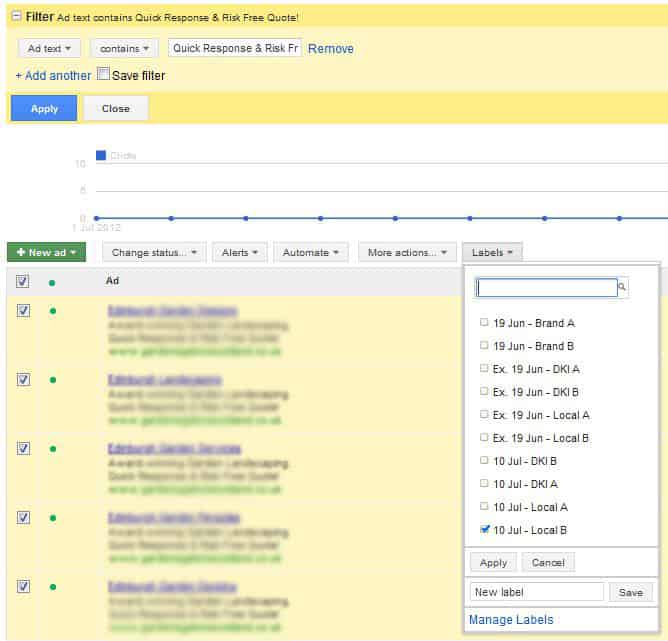
Once all the ads are up, filter the ads by the distinguishing variations in the ad text, and then apply a label to them that includes the date, the test name and the variation number or identifying quality. Repeat this for the other variations in the test.
3. save dimensions column layout
Go to the Dimensions tab and save a columns layout that will show Labels, Impressions, Clicks, Conversions, CTR and Conversion Rate. Then once your ads have begun collecting data, return to the Dimensions tab, select the saved column layout and you can quickly review (by selecting View/ Labels/ Labels – Ads from the drop-down at the left) how your ads are getting on. Because the date’s there, you’ll always know what date range to look back to when reviewing each test.
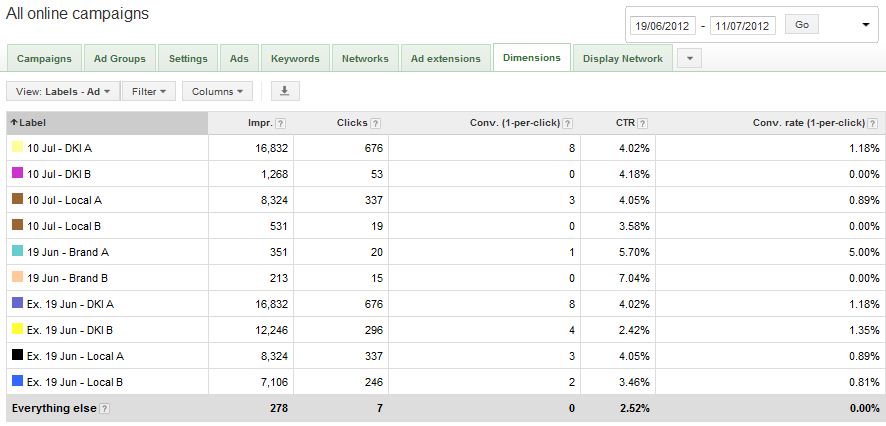
4. measuring the significance
Once you suspect you may have a good enough data sample size, download the Dimensions report. The next step is measuring the statistical significance of the data sample, and we recommend using this tool by Chad Summerhill. There’s an instructional video to explain more on how to use it. As I said above, grouping ad group data together can sometimes jeopardise the validity of the data especially when ad groups have only small levels of traffic, as it’s ignoring the fact that we’re actually running a different test in each ad group. If this is a concern for you then you may want to try Chad’s other tool (he’s a generous guy, eh?): the Cross Ad Group Testing Excel Template.
5. end the test
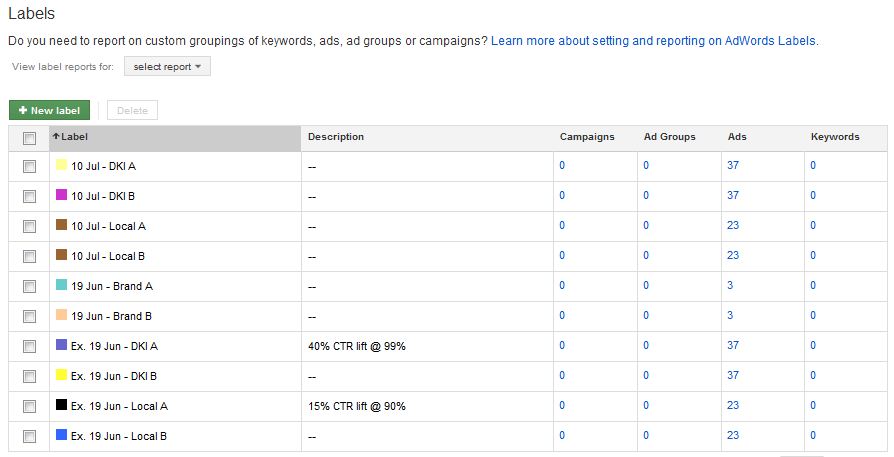
Yay – statistical significance! Pause the losing ad variation, and then in the Labels area of the interface (not the dimensions tab, the link is at the bottom of the left hand panel of the interface) leave a description on the winning ad variation of the uplift and the confidence level reached. We’d also recommend at this point changing the name of the labels to signify it has now ended (but leave the date, name and variations info).
6. the next ad test
When you create the next test in all likelihood you’ll want to continue testing the champion from the last test against the new contender. In this case, label the ads with the new test start date, name and variatons as before, but keep the old label on the champion ad variation as well. A really good ad will display multiple coloured labels as badges of honour from all the ad copy tests they’ve succeeded in.
summary
Using labels to manage your ad copy tests means you don’t have to compile all your ad group data with a pivot table (as the Dimensions tab does this for you), you don’t have to keep a record of which ad tests are running (as the labels themselves do this), when they started running (the label names do this) and you can also keep the results of the tests in the actual interface rather than an external spreadsheet (with the Label description column).
other uses for labels
Ad copy is just one of the many things labels can help with. How about picking out your top performing keywords across your account, and then setting an automated rule to ensure these keywords maintain a certain ad position or to monitor any drop in their traffic levels? Or how about using labels to mark a recent upload of new keywords so you can monitor their performance separate from the original account? They can help with reporting too, particularly for agencies who manage multiple accounts and need to separate ones based on the reporting they require.
It’s just a shame the latest update of AdWords Editor still doesn’t support them!
 photo credit: foxypar4
August in Edinburgh means one thing for many people – yes, festivals!
There’s the International Film Festival, The Book Festival, The Art Festival and of course, The Fringe…but there is another festival running for 3 days, and that is not to be missed in Edinburgh this August – The Turing Festival.

Named in honour of Alan Turing, not heard of him? Well, really you could say he is the founding father of modern day computing , it’s largely thanks to him you are reading this on some sort of computing device now. The festival is a collaboration between the European Open Innovation Project, Edinburgh City and Interactive Scotland and runs this year from 23rd – 25th August.
It’s a full scale celebration of all things digital and web related and last year saw a pretty impressive speaker line up including open source creator Richard Stallman, Pirate Bay co-founder Peter Sunde, Google’s head of social for EMEA Ade O Shineye and Albert Wenger – Partner at Union Square Ventures along with many other big, big names. The festivals founder and director Dr Jamie Coleman described it as:
“…a bit like SXSW meets TED but in the middle of the world’s largest and craziest arts and cultural festival, the Edinburgh Festival and Fringe…This is a real festival rather than a conference or trade show and as such is a celebration of technology. There are many simultaneous events that are individually ticketed. I have programmed the festival to go from very public events through to deep technology and tech business/startups.”
what happened last year?
We spoke to Stephen Dunn, one of the speakers at The Turing Festival last year when he was Head of Strategy and Architecture at Guardian News and Media. He now works for the Government Digital Service and despite only being able to get to the festival for a few hours had this to say:
“It was fantastic to see some global experts like Albert Wenger, speaking alongside local experts- and I got as much out of hearing both. It was great that it was a showcase for local (ie scots talent) as well as bringing the global view in.”
Emma Miller spent a day at the festival in 2011 when she was working for a start-up and found it to be:
“full of stimulating debate and cutting edge information that anyone in tech will value…I’d say my favourite part was Stallman’s talk about keeping our identities private in this over-digitalised age. There was a lot of debate on how Facebook affects our personal life and do we really want to move our relationships to a digital platform? Is it bringing people together or making us more distant as a society?”
Emma also mentioned, and how could you not, that the Fringe is also going on at the same time so after you are full up of techy goodness you can head off and immerse yourself in the lands of the arts!
Here is a video of last years highlights!
Highlights from the Turing Festival 2011 from Interactive Scotland on Vimeo.
this year…
This year Turing will be based in both Appleton Tower (Edinburgh University) and Our Dynamic Earth, the programme of events is on their website and tickets are available to buy.
This year looks set to be as big if not bigger than last – Dr Jamie Coleman is yet to make the big announcement about this years headline act but major events he can reveal include events from CERN, National Geographic Explorers, BBC, Venture Capital and Angel investor events.
Dr Coleman explained that from this years ‘Global Technological Celebration’ he is:
“…most looking forward to the enlarged festival for Alan Turing’s centenary this year. We go from music and arts right the way through to medicine and physics (CERN). The theme is “digital everywhere” and we have something for everyone.”
Headlining the Education Technology event is Raspberry Pi, the £25 computer manufacturer with a mission to get us all coding.
Other speakers at the festival include Ross Anderson (security expert and author) David Allen Green (lawyer and blogger) and Nicolas Merrill (who went up against the US patriot act) who will be heading up the Security and Freedom event.
Other tracks include Future Medicine, Gaming and the main event itself “Connected World”
And around the main programmes are organised hackathons, private CEO events, a startups party and we are told there are lots more announcements to come.
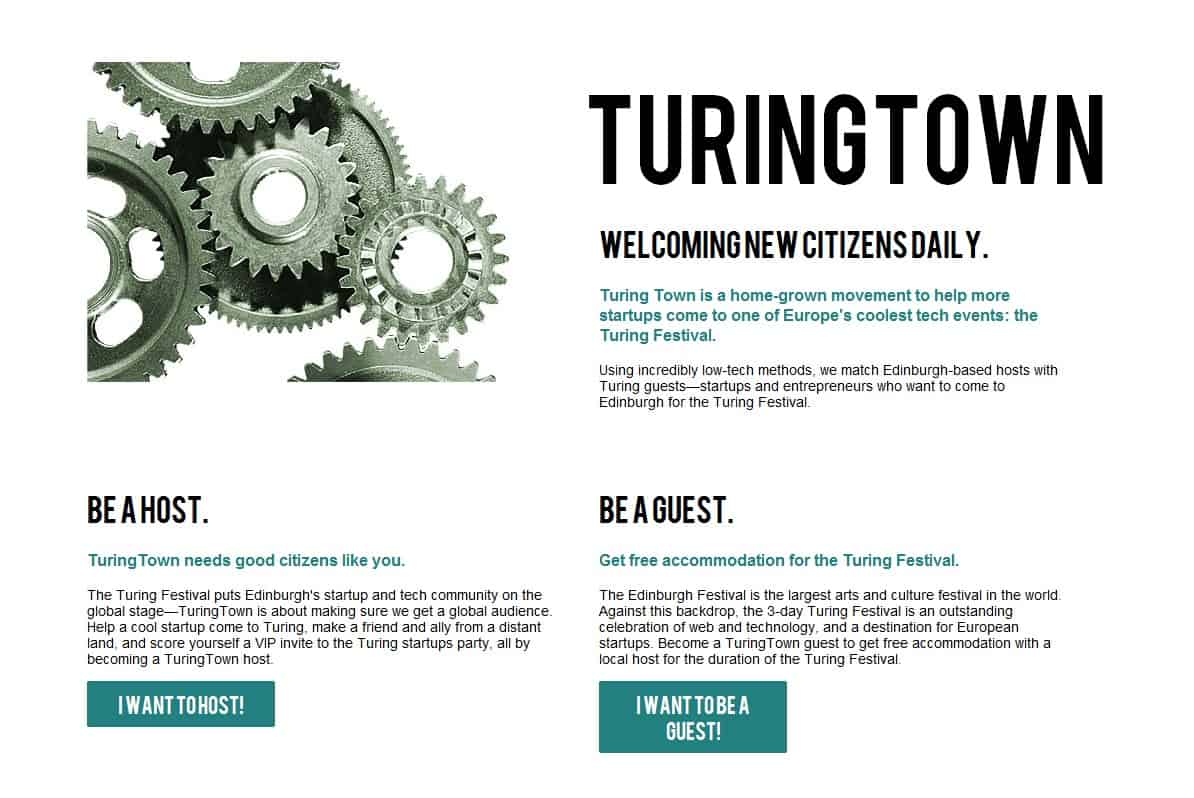
And for some extra techy love this year Turing Town has been born – matching hosts with guests, everyone benefits! You can host a guest to the Turing Festival giving them free accommodation in Edinburgh and in return bag yourself a VIP invite to the Turing startups party!
So whether you are a hardcore geek, or simply like a good email or tweet, The Turing Festival gives you a chance to gather and swap ideas and is definitely worth heading to this August.
To keep up with what is going on on the run up to and during the festival if you cant make it along you can ‘follow’ them on Twitter or ‘like’ them on Facebook.
The UK is going mad for online discounts – the BBC programme The Apprentice aired on 23 May, where contestants had to source deals for such a business, highlighted this.

daily deal stats:
- According to organisers of Europe’s first Daily Deals Summit held in March, in just 6 months, from July to December in 2011, Britain spent £3 billion through daily deal websites such as Groupon.
- Voucher sites have taken over sitting at 37.4 million UK internet visits in December 2011, up 28% in a year, as visits to price comparison sites have halved year-on-year according to Hitwise.
- LivingSocial claimsthat its voucher sales have almost doubled when compared the previous year.Managing Derector of LivingSocial UK and Ireland said,
Over the last 12 months we have been rapidly expanding to offer membership to more UK consumers, and it is fantastic to see that the popularity of people trying LivingSocial, and discovering more about where they live, shows no signs of slowing down.
Looking at Edinburgh specifically we have a few main offer sites: Itison, Today’s Great Deal, KGB Deals, Wowcher, LivingSocial and Groupon, but the list is growing every year. Also, with the addition of Facebook offers into the market there is a question of whether pre-pay and sign-up deal sites will be superseded by instant login, socially-connected offerings. With the information that a hotel in Ireland made over $1 million in 24 hours on Facebook offers it’s a tempting deal for businesses.

the good bits…
Along with giving you offers such as 2 for 1 meal deals or even 70% off tooth whitening, daily deal or voucher sites can be incredibly helpful for businesses in a number of ways:
- Ensure restaurants fill up midweek tables that may have otherwise gone unsold
- Offer businesses the chance to reach out to potential new customers
- Build up a new contact data base for future promotions
When it works it becomes about getting as many people through the door when business is quiet and promoting the brand. If done well voucher and deal sites have the potential to be very successful for small businesses.

…and the bad…
If a business doesn’t do their homework, however, a daily deal or voucher marketing idea can spell trouble:
- Some daily deal business models take about 50% of all voucher sales
- The business must also be prepared for what could be a very busy time for staff: booking in and dealing with new customers while trying to up-sell in order to make back some of the lost income
- In some cases this is causing the business themselves to lose out on making money in order to promote themselves on these sites
big slap on the wrist for Groupon
At the end of 2011 daily deal sites came under some fierce criticism for over selling vouchers, mostly on behalf of small businesses who would have needed to risk bankruptcy in order to service these deals.
Indeed in mid-March the British arm of Groupon got its knuckles rapped after The Office of Fair Trading said it had found breaches of consumer protection rules. Groupon now have three months to ensure offers are realistic and prices are transparent and accurate.
Groupon stats
UK based Copywriters Cooper Murphy conducted a survey into Groupon that found out:
- 82% of Groupon Business users were unsatisfied with customer repeat business
- 50% of Groupon business users would not advertise with the company again
- 65% said that Groupon was profitable for their business

Vouchers drive footfall but is this more of a fair-weather customer and not really what a business wants? Indeed in the Cooper Murphy survey 78% of merchants believed that people who buy vouchers of Groupon are more ‘stingy’ than regular customers. Surely the true goal of a business would be to generate a loyal customer base who will frequently visit without the need for discount or incentive, talk about their experience and get others to come and spend more each time – not just to get a lot of people through the door.
Itison.com
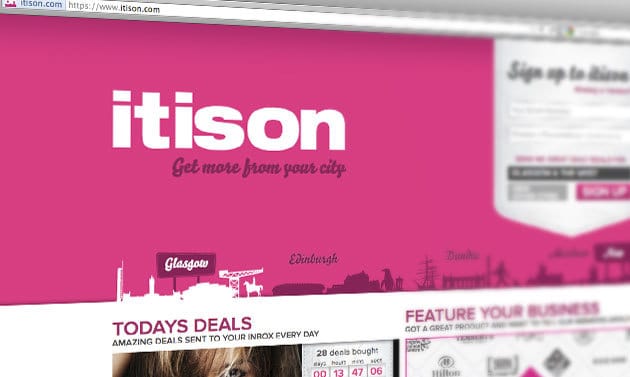
Let’s look at one local daily deal site in a bit more detail. Itison.com is a free-to- join website sending out daily deals to its members based in Edinburgh, Glasgow, Dundee and Aberdeen.
Itison takes 35% commission, however we have been told from a source that this is negotiable. We have spoken to one of the business who has offered deals on their site before and he cannot speak highly enough of them!
Eddie Brown, a personal trainer and director at Edinburgh City Boot Camp has run deals with Itison and has profited from this promotion.
He has, in fact, found that the quality of the Itison customer is “very high compared to a lot of deal companies” and this has lead to a 40% conversion rate from buying the offer to being a full-time customer with his company. His overall aim when deciding to run an offer was “to broadcast the business through their large database and let people experience my product”, and he has found this approach to be successful. Eddie has found the process of working with Itison a positive one and has some tips for another business looking to promote with a daily deals or a voucher website:
- Ensure you have an efficient booking system and follow up procedure for a return visit for customers.
- Make sure you can cope with the volume of new customers and make sure they get the same quality of product or service as everyone else.
- I have used 6 daily deals companies and their customers from different daily deals companies are very different: one did huge volume but conversions were only 10%. So decide what price point you want and volume would suit you best and do a little bit of research or ask around.

We also spoke to Reuben Welch, a partner of Alien Rock climbing centre, who have used Itison, Groupon, Living Social and Deal Monster to run offers. They haven’t been running their Itison offer long enough to know how many people will return after purchasing a voucher but said that Groupon gave them around a 10% return rate and Living Social around 20%. The promotions they run don’t give them huge profits; they run them to just increase awareness of Alien Rock and to make some money. Reuben also gave us his top three tips:
- The amount of repeat custom is likely to be low – don’t factor it into the financial calculations, it’s a bonus! The deal must stand up financially on its own, even if it just breaks even.
- Make sure you have plenty of good third-party reviews online before running the deal and that your website is up to scratch – people will research you before buying.
- Set your terms with them rather than the other way around e.g. 30% commission, payment on ALL valid sales, voucher validity to suit you, bulk payments to reduce paperwork. Set realistic caps on sales.
In an interview with The Drum in November 2011 Oli Norman, Founder and Managing Director of Itison, stated that they focused on “customer service, favourite brand terms and quality deals”.
We spoke to Jenny Wallace, Itison’s Director, who let us know that Itison clients can:
‘cap’ their deals to ensure that their feature is not oversold. We work closely with our clients to ensure that caps are manageable and controllable
They can also implement blackouts times on deals to try and avoid the problems Groupon ran into when more vouchers were sold than companies could handle. Jenny explained another way in which they avoid acting in the same fashion as Groupon is that Itison are very careful to ensure their top price is accurate, whereas Groupon have allegedly been known to inflate theirs in order to make the saving seem larger.
Jenny also had three top tips for a business looking to run a promotion with a daily deals site:
- Ensure your deal is structured to allow up-spend from your purchaser.
- Ensure your cap is controlled. The key to a deals success is the customer having a positive experience and seeing your business run to its optimum, not feeling like they’re being cattle herded!
- Treat your deal customers like gold – they are as valuable to you long term as your full paying customers.
Itison stats
In fact when it comes to daily deal sites Itison have some pretty impressive stats:
- 92% of their members use Itison to discover new places
- 88% of members have returned to the deal venue as a full paying customer
- The average Itison purchase is over £70
- 96% of Itison’s hosts would run another deal with them
- 73% of hosts even said that an Itison member is worth as much or more to their business than regular customers.
in the end
So it seems the rise of the voucher and daily deal site is almost unstoppable, and it makes sense: why would you pay £210 for an MOT when you only need pay £39 with a voucher, or receive laser liposuction for £592 when it’s £99 with a voucher. It’s the cheaper way of living an expensive life, through a piece of paper printed out from a website. Huge as the appeal will be to businesses looking to appear on the site it takes some consideration. Depending on your reasoning, what type of business you are, how you use it, and what deal site you go for, it could be a huge hit or a huge disaster…
It’s the big news in SEO – recent changes to Google’s search ranking algorithms named Panda and Penguin.
Over a three week period in April 2012 these major iteration updates or ‘filters’ to the algorithm have affected how certain links and sites are perceived, and has caused some sites to slip or even completely lose their positions in Google search engine results pages (SERPs). So what are they in simple terms?
 Google Panda
Panda is thought to be a change to how the algorithm assesses on-page factors and usability – so that’s things like:
- · quality
- · depth and duplication of content
- · prevalence of adverts
- · ‘overoptimisation’
(trying to hard to optimise for search engines and forgetting users)
Sites that scrape or copy content from elsewhere, produce ‘thin’ or low value content on a grand scale, are heavily templated/database generated content or sites that are plastered with Adsense adverts are all types of sites that have been ‘hit’ by the update.

Google Penguin
Penguin has been considered an equivalent filter to to Panda but targeting offsite factors – so that’s things like:
- · links and low link quality
- · link networks
- · social and comment link spam
- · footer and sidebar (not content) links
- · sitewide links
- · overall site link profiles
- · anchor text
Although there’s not full agreement about what the change actually means (the only way we can know is by looking at sites that have been hit or devalued), the consensus is that Penguin has worked with the Panda update to really hit the value of links from spammy, low value sites, and has reduced the value of ‘unnatural’ links such as footer and sitewide links i.e. links that are not relevant or in context.
It also seems to be looking at overall site link profiles, with sites that have a prevalence of low-value links (low PageRank or DomainAuthority) with few higher quality also being affected.
It’s been proposed that anchor text (the words that are linked from) has been devalued or become a significantly less important part of the algorithm, with Google perhaps now being far more educated about what a site is about that it doesn’t need to rely on the anchor text words to spell it out for it.
It’s also highly likely that unnatural anchor text profiles i.e. sites that have unvaried, mostly keyword rich (overoptimised) anchor text and little brand anchors have been negatively affected.
read more
If you want a bit more insight I’d recommend you read the excellent Penguin and Panda discussion involving a load of top SEO pros collected by CognitiveSEO.
what’s it all for?
The overall aim of these updates is to reduce web and link ‘spam’, so that low quality links and low value sites are reduced or even removed from consideration of the algorithm and therefore search results. Has it been an total success? No, there are many instances of sites being penalised that perhaps shouldn’t have been, and sites dropping because of more ‘unfortunate’ than spammy practices.
However, with consistent iterations and updates it’s likely to really reduce the effect of spammy and low-quality SEO techniques – which can only be a good thing.
Images from the ever-excellent NatalieDee.com

If you’ve been managing an AdWords account this week you’ll probably have noticed a pop-up notification about changes to the way AdWords uses Phrase and Exact match: plurals and misspellings will now be included by default.
changes to Exact and Phrase match
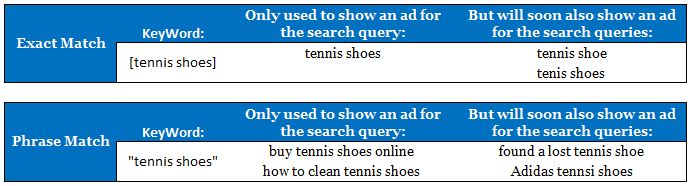
Lets take each seperately and compare:
multiple match types in an account
I like Exact Match because it is exactly that – exact. Keeping two or more match type variations of the same keyword allows you to split the data, rather than all the eligible search queries being triggered by the same keyword. This means you can compare the performance of an exact keyword with everything closely related to it, and can speed up the time it takes to identify potential relevance issues.
the new match types example
Let’s continue with the time honoured example of the humble tennis shoe to show what search queries wouldn’t be triggered by the new Phrase match type, and if you switched to the often underappreciated modified broad.
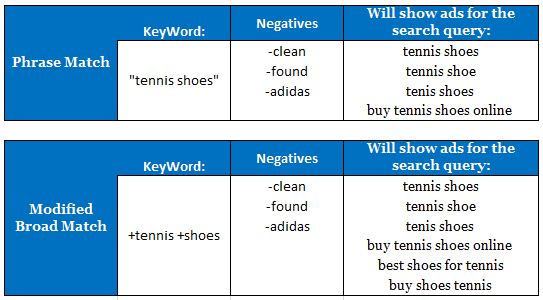
This is only a selection of eligible terms and there is still a huge number of unknowns out there, and do not rely on your Search Query Report to make you aware of them as this will only ever show you a fraction of them. Modified Broad (like Phrase to a lesser extent) comes at a price and you need to invest time in negative keyword research to improve it’s efficiency. Below compares the eligible keywords again, but now with a small selection of negative keywords.
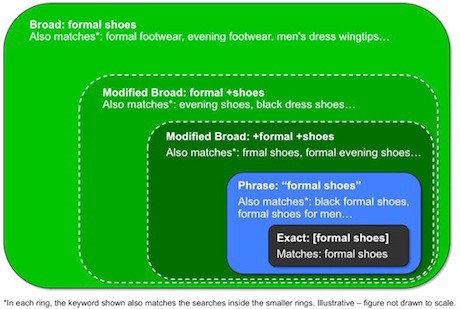
how does Modified Broad work?
Modified Broad is actually more closely related to Phrase match than it is to Broad. While Broad match predominantly uses past Click Through Rates to determine how relevant a user’s search query is to your keyword, Modified Broad uses plus signs as ‘anchors’ to insist that that word must be within the search query.
when to use the new match types?
If you’re really tight for time and don’t need the extra level of sophistication that comes with splitting keyword data across multiple match types then I’d recommend accepting the new changes to Exact and Phrase match types, unless you have any very closely related brand terms that may confuse Google into thinking its a misspelling. However if you’ve got the time or the know-how to do it quickly and efficiently, I’d recommend splitting the keyword data by several match types, including different modified broad variations. Either way, remember your negative keywords!